Around 11:30 AM on Monday a man wearing an orange teacosy on his head and a matching gown squirted a watery liquid into my mouth from a green stained plastic bottle. I'm as confused as you are right now, providing context won't really clarify things but I'll give it to you all the same.
I'm interning with Action Now Kenya (ANK), a small non-profit which provides micro loans and business training to people living in the informal settlements of Nairobi. ANK has three full time employees and four community workers who occasionally report back to home base. In 2007 ANK started working as a partner organization with the microfinance agency Kiva (http://www.kiva.org/). In this relationship Kiva dealt with the investors and ANK dealt with the clients (the people receiving the loans). Soon after partnering with Kiva, ANK and Kiva dispersed over $100,000 in small loans. The timing, however, was incredibly bad, just a few months later post election violence erupted in Nairobi (http://tinyurl.com/ycuwu5j). The fires, violence, displacement of people, and looting were most intense in informal settlements and so many of ANK's clients were unable to pay back their loans because their businesses were destroyed or looted. When Kiva asked for money from ANK to pay back the investors, ANK wasn't able to reimburse the investors at once and is still trying to do so today. On a positive note, ANK recently started a new loan program independent from Kiva. On Monday I went into Kibera to meet some of our current and prospective clients.
Kibera, and informal settlements in general, are difficult to explain so I'll save most of the details for another blog post. I'm pretty sure that over half of all small businesses in Kibera are either hairdressers or dressmakers/tailors, and so on Monday I met some hairdressers and dressmakers/tailors. I mostly enjoyed the dressmakers because they had beautiful old sewing machines and tended to employ/train other community members. I also met a doctor who runs a clinic which has been burnt down on two occasions and which he has rebuilt doggedly after each disaster. I met a man who makes the best Mandazi (less sugary but better than doughnuts) in Kibera. I met an old lady who sells onions at a stall at 10 cents an onion. I ate a lunch of chapati (kinda of like a tortilla) with beans and kale at the hotel (which translates to restaurant) of one of our clients.
I was also invited into the house of the husband of a prospective client. He happened to be a priest of a church particular to Kenya and was wearing an orange teacosy on his head and a matching gown (I guessed they had something to do with him being a priest, although I'm still not entirely sure). I'm telling you about the teacosy and gown mostly because I was taken aback when I first saw them but when I learned he was a priest they began to make just a little sense to me. On second thought maybe the hat looked more like a chef's hat, but not the kind that look like a soufflé, instead the kind that looks like a cylinder. In any case, in one corner of his house he had an elaborate alter with many differently colored candles, religious images, rosaries, and shepherds' frocks. I talked to this man for a while about his wife's business before conversation turned to his alter. He picked up or pointed to each item and told me its significance. Eventually, he picked up a green stained bottle and...you already know the rest. I found out later that the liquid was blessed water that had been boiled with special curative herbs. The whole incident was really quite strange.
After walking all over Kibera to meet clients I was happy to get back to my apartment and relax.
Wednesday, September 29, 2010

Sunday, September 26, 2010
Explanations for the last two photos
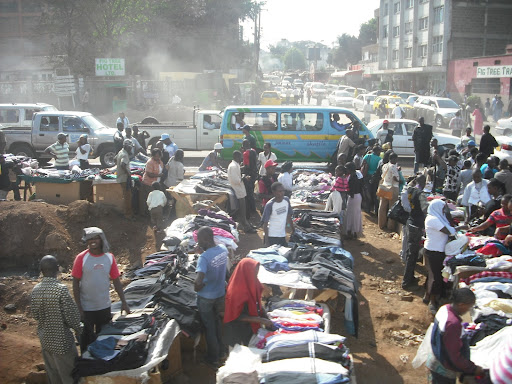
The first picture shows traffic running around a market. The photo only shows a sliver of the actual market which is a large triangle enclosed by three of Nairobi's highways. Vendors of second hand clothing arrive to the triangle early in the morning and set up their mobile tables and start selling their goods. The market is just outside the main section of town where all the tall buildings sit. People either jump off matatus or play frogger (http://en.wikipedia.org/wiki/Frogger) across the busy highways to get to the tables. I only brought 3 pairs of pants with me so I'm hoping to find another pair here one of these days (I haven't decided yet whether I'm serious or not).
In the background of the photo there's a blue van. This is a matatu. Matatus are the main mode of transportation around Nairobi. These vans can fit 14 passengers, a driver (this term is relative to nairobi, in the US we might call him or occasionally her an "attack driver"), and a conductor (again a relative term). Mataus usually have loud rap or 70s music playing and sometimes have tv screens showing music videos. Matatus also usually have bizarre stickers on the windows like "have you thanked a green plant today?", "God's love", "Jesus is Lord", "Chris Brown", "naked boy", "SMS only", "big gun", and "speed demon." Like ships, matatus have names, and the names of the vehicles themselves are sometimes even more amusing than their stickers. Some examples include: "Dark Knight", "Junior", "Lover Machine", "Hand of God", "Lady Luck", and "Death Trap." I'm going to start recording matatu names and stickers in a notebook (as soon as I get a notebook, that is).
Now that you've become acquainted with the vehicles themselves, you need to know about their operators, drivers and conductors. The driver and conductor of any given matatu can communicate better than any two human beings on the planet. The conductor sits next to the sliding door on the left side of the matatu and can easily hop out of the vehicle to allow passengers to exit or enter. Conductors tend to ride standing with their feet inside the matatus while their heads and upper bodies remain outside the vehicles. This way, they can see over the roofs of their own matatus in order to assess traffic situations and decide whether their drivers should create new lanes (between other lanes of traffic or on the unpaved sidewalks... there are no lines painted on the roads to designate lanes). The conductor usually taps a coin twice against the roof of the matatu to signal to the driver to stop to let passengers off or onto the vehicle. Signals to create new lanes, cut off buses, etc., are not always as easy for passengers to understand, and vary from matatu to matatu.
Matatus are simultaneously insane, hilarious, cramped, terrible, and wonderful. And you can't really get anywhere without one. Here's some links (oh yeah, these look clunky, how can I make them not clunky?) :http://www.google.co.ke/images?um=1&hl=en&rlz=1C1ASUT_enUS373US373&biw=1366&bih=667&tbs=isch:1&sa=1&q=matatus&btnG=Search&aq=f&aqi=&aql=&oq=&gs_rfai= , http://www.flickr.com/search/?q=matatus&page=2 , http://www.worldhum.com/features/travel-stories/the-mad-matatus-of-kenya-20100315/
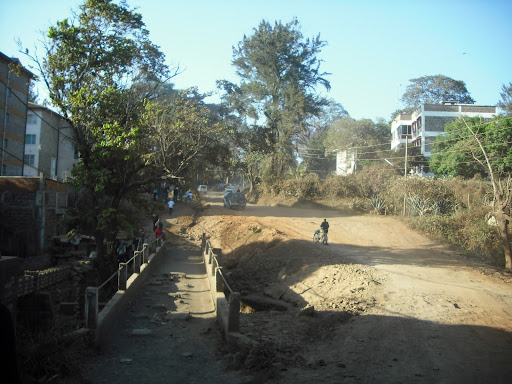
The second picture is of a street I use to get the the AU Abroad program office on Tuesdays, Thursdays, and Fridays. I posted this picture because I wanted to show Nairobi's dust and pollution. There's a lot of both. Where there's no pavement, cars and feet stir the loosely packed dirt into the air. Grass doesn't seem to grow in most of Nairobi. If you walk around in sandals (I do) your feet quickly get red dirt tattoos around the straps of the sandals. All my shoes now look like dirt. After washing my feet in the shower I need to wash the shower to get the red dirt stains off the floor. The dirt is endless.
In addition to constant dirt, the cars, trucks, and matatus of Nairobi spew black smog. I kind of doubt gasoline in Nairobi is unleaded (correct me if I'm wrong), and after a day of walking around Nairobi my snot turns black. The smell of burning garbage isn't uncommon in the city and is constantly coming in through my apartment's window. Usually, ravines of litter run parallel to foot paths (packed dirt) along the sides of roads (although I imagine some of it will be washed away during the rainy season [it hasn't rained since I've been here]). During the twice daily commute the black fumes of vehicles intensifies the nausea associated with traffic.
Micaela helped write some of this post while I looked after some cooking pasta. She'll guest post sometime soon. She's also my constant editor (please don't blame her for my terrible writing though).
More soon.
In the background of the photo there's a blue van. This is a matatu. Matatus are the main mode of transportation around Nairobi. These vans can fit 14 passengers, a driver (this term is relative to nairobi, in the US we might call him or occasionally her an "attack driver"), and a conductor (again a relative term). Mataus usually have loud rap or 70s music playing and sometimes have tv screens showing music videos. Matatus also usually have bizarre stickers on the windows like "have you thanked a green plant today?", "God's love", "Jesus is Lord", "Chris Brown", "naked boy", "SMS only", "big gun", and "speed demon." Like ships, matatus have names, and the names of the vehicles themselves are sometimes even more amusing than their stickers. Some examples include: "Dark Knight", "Junior", "Lover Machine", "Hand of God", "Lady Luck", and "Death Trap." I'm going to start recording matatu names and stickers in a notebook (as soon as I get a notebook, that is).
Now that you've become acquainted with the vehicles themselves, you need to know about their operators, drivers and conductors. The driver and conductor of any given matatu can communicate better than any two human beings on the planet. The conductor sits next to the sliding door on the left side of the matatu and can easily hop out of the vehicle to allow passengers to exit or enter. Conductors tend to ride standing with their feet inside the matatus while their heads and upper bodies remain outside the vehicles. This way, they can see over the roofs of their own matatus in order to assess traffic situations and decide whether their drivers should create new lanes (between other lanes of traffic or on the unpaved sidewalks... there are no lines painted on the roads to designate lanes). The conductor usually taps a coin twice against the roof of the matatu to signal to the driver to stop to let passengers off or onto the vehicle. Signals to create new lanes, cut off buses, etc., are not always as easy for passengers to understand, and vary from matatu to matatu.
Matatus are simultaneously insane, hilarious, cramped, terrible, and wonderful. And you can't really get anywhere without one. Here's some links (oh yeah, these look clunky, how can I make them not clunky?) :http://www.google.co.ke/images?um=1&hl=en&rlz=1C1ASUT_enUS373US373&biw=1366&bih=667&tbs=isch:1&sa=1&q=matatus&btnG=Search&aq=f&aqi=&aql=&oq=&gs_rfai= , http://www.flickr.com/search/?q=matatus&page=2 , http://www.worldhum.com/features/travel-stories/the-mad-matatus-of-kenya-20100315/
The second picture is of a street I use to get the the AU Abroad program office on Tuesdays, Thursdays, and Fridays. I posted this picture because I wanted to show Nairobi's dust and pollution. There's a lot of both. Where there's no pavement, cars and feet stir the loosely packed dirt into the air. Grass doesn't seem to grow in most of Nairobi. If you walk around in sandals (I do) your feet quickly get red dirt tattoos around the straps of the sandals. All my shoes now look like dirt. After washing my feet in the shower I need to wash the shower to get the red dirt stains off the floor. The dirt is endless.
In addition to constant dirt, the cars, trucks, and matatus of Nairobi spew black smog. I kind of doubt gasoline in Nairobi is unleaded (correct me if I'm wrong), and after a day of walking around Nairobi my snot turns black. The smell of burning garbage isn't uncommon in the city and is constantly coming in through my apartment's window. Usually, ravines of litter run parallel to foot paths (packed dirt) along the sides of roads (although I imagine some of it will be washed away during the rainy season [it hasn't rained since I've been here]). During the twice daily commute the black fumes of vehicles intensifies the nausea associated with traffic.
Micaela helped write some of this post while I looked after some cooking pasta. She'll guest post sometime soon. She's also my constant editor (please don't blame her for my terrible writing though).
More soon.
Saturday, September 25, 2010
Photos
I guess I'll post photos on my blog through the website picassa. Ask questions if you have any. Thanks.
http://picasaweb.google.com/112106311510324340502/ThoughtsAndStoriesFromKenya?authkey=Gv1sRgCNu5xq-BzvGi1gE#5520743230828007394
http://picasaweb.google.com/112106311510324340502/ThoughtsAndStoriesFromKenya?authkey=Gv1sRgCNu5xq-BzvGi1gE#5520743230828007394
Long time no blog
This post represents an attempt to explain why I haven't posted as frequently as I'd like.
Here is my schedule:
Monday and Wednesday: wake up at 5:45, leave apartment at 6:45 and get on some form of transportation, either one of Nairobi's bizarre buses or a matatu (I'll write a post about matatus soon) by 7:15. I get into down town Nairobi by 7:45 and catch a City Hoppa (one of Nairobi's bus companies) and get to my internship with Action Now Kenya (I'll post about this as well) at 8:30. I work there until 4:30 with a break for tea and a break for lunch. I then retrace my steps back to my apartment and get back around 6:30.
Traffic lengthens the commute. I'm trying to take pictures that will show the chaos of Nairobi traffic but without a helicopter I'm not sure I can really give you a good idea of what it's like.
On Tuesday and Thursday I wake up at 6:30 and leave the apartment by 7:25 so that I can walk to the AU Abroad program office and arrive in time for my 8:00 Kiswahili class. After class I catch a matatu to down town Nairobi and catch the shuttle service to USIU (the university I'm attending here). My first class, African Authors Seminar, runs from 11 to 12:40. My next class, International Economics and Trade, runs from 1:20 to 3. I then catch the shuttle back to down town Nairobi and take a matatu to Westlands, my neighborhood, arriving back around 5:30.
Again on Friday I have Kiswahili at 8 and afterwards I have Politics and Culture in Kenya, which is really a class on the process of urbanization in Nairobi, it runs from 9:30 to 12:30.
To put it succinctly I've been quite busy. I usually fall asleep against my will some time around 10 while trying to catch up on some reading, to the endless amusement of my wonderful roommates.
More blog to come!
Monday, September 6, 2010
woops, I forgot
About the lack of photos... until the past couple days I've let other people do the taking of photos. The next post should involve a lot of photos! But for now I'm linking to sasha's wonderful facebook gallery and blog!
links to sasha:
http://walkinmyeyes.blogspot.com/
http://www.facebook.com/album.php?aid=262355&id=501389251&ref=mf
links to sasha:
http://walkinmyeyes.blogspot.com/
http://www.facebook.com/album.php?aid=262355&id=501389251&ref=mf
Subscribe to:
Posts (Atom)